
Leisure as a Game of Permissions: Women’s Leisure in Contemporary India
A conversation with Surabhi Yadav on documenting leisure practices among women in rural and urban India
This article was originally published in the Journal of Vrijetijdstudies.
Surabhi Yadav's Project Basanti: Women at Leisure began with a straightforward observation: she had no clear memories of her mother being playful. After her mother's death when Surabhi was twenty-three, she started interviewing people from her mother's life. One friend's opening line "Your mother was very goofy and naughty" didn't match Surabhi's recollections at all. She remembered the household manager, the woman caring for four children, the taskmaster. Not someone goofy.
This disconnect raised an obvious question: who was her mother when she wasn't performing the role of mother? The answer led to a seven-year photographic project documenting women's leisure across India, which has since grown into a 35,000-strong online community and spawned research initiatives examining gender, visibility, and access to rest.
Surabhi does recall one annual exception. During Holi, the festival of colors in northern India, her mother would initiate improvisational role-plays among neighborhood women. She would boldly embody characters completely unlike her daily persona, from drunk husbands to argumentative daughters-in-law. Other women joined for hours of raunchy, joyful performance. Outside of this situation, that personality would vanish, until aroused the following year.
The pattern reveals how women's access to leisure is forced to be structured, contained within specific sanctioned moments, permitted often only during religious festivals, requiring immediate containment afterward. Surabhi now wonders where that playful, improvising personality went the rest of the year and why it could only emerge once annually.
Reframing Leisure
The conventional definition of leisure as time free from obligation doesn't capture what Surabhi observed through her documentation. She proposes instead: "a window of space and time when your guards are down as much as possible, when you're not performing, when you're just being yourself."
This reframing matters. Surabhi shows a photograph of her sister-in-law lying on the floor, hands propping up her head, in front of a Zumba training video, not exercising (below). "She's not performing even the exercise that she signed up for...She's at leisure." The personal choice of how to interact with even formal leisure activities becomes itself a form of leisure.
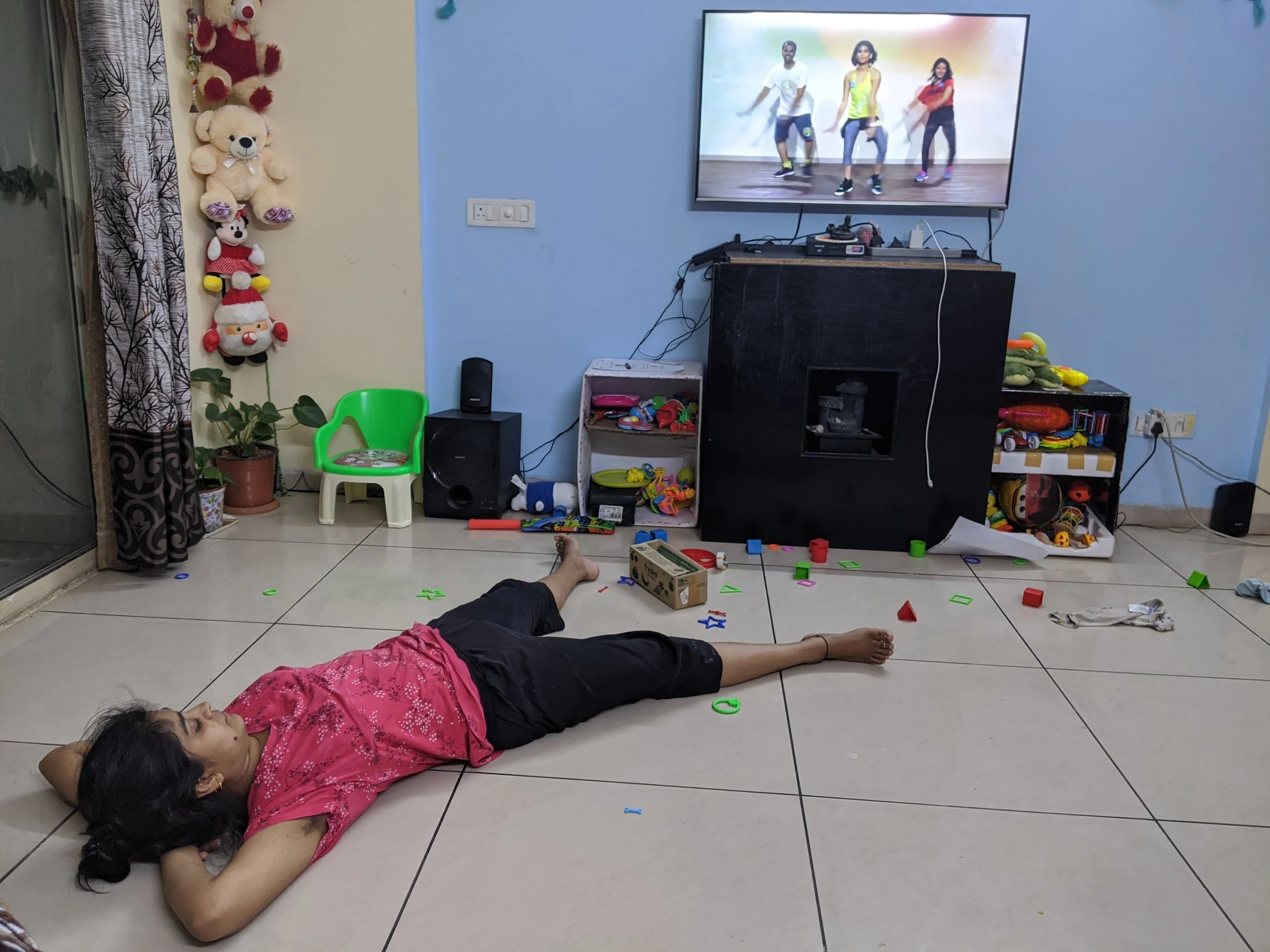
Copyright Surabhi Yadav
This framing reveals complexity in lives typically represented through binary extremes. Bollywood portrays rural women either as completely innocent with highest morality or as entirely helpless victims. "When you swing in this extreme, what you miss out is a whole range of complexity of identities." Surabhi asks: "It's easier to imagine suffering of someone facing triple layer of oppression; gender, caste, class. What does their joy look like?" The Women at Leisure archive documents joy, but also contemplation, solitude, and community among people typically represented only through suffering or survival.
One significant finding: marginalised groups often maintain strong access to collective joy and community, challenging assumptions about who has quality leisure access.
Permissions
Surabhi's central concept: "Leisure is a game of permissions." Who gets to do what with their time and where gets determined by social standing.
Copyright Surabhi Yadav
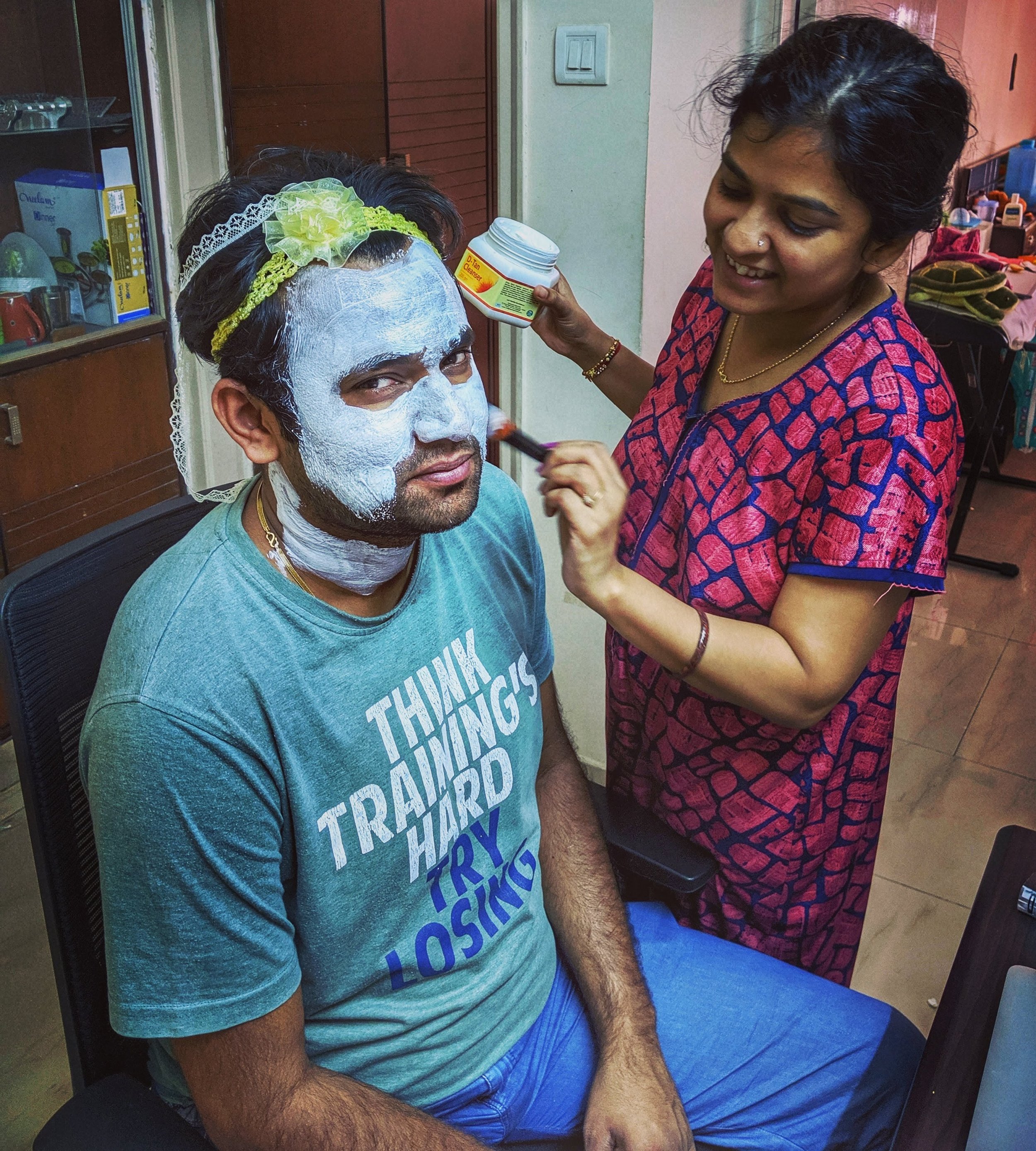
Communal bathing and grooming routines, a common Indian household practice involving hair oiling or facial masks, remains accessible to girls and women throughout their lives. Boys receive it when young but lose access as they mature. When Surabhi photographs her brother receiving this care, he uses a girl’s headband because he doesn’t have his own (above). Even basic self-care becomes gendered territory.
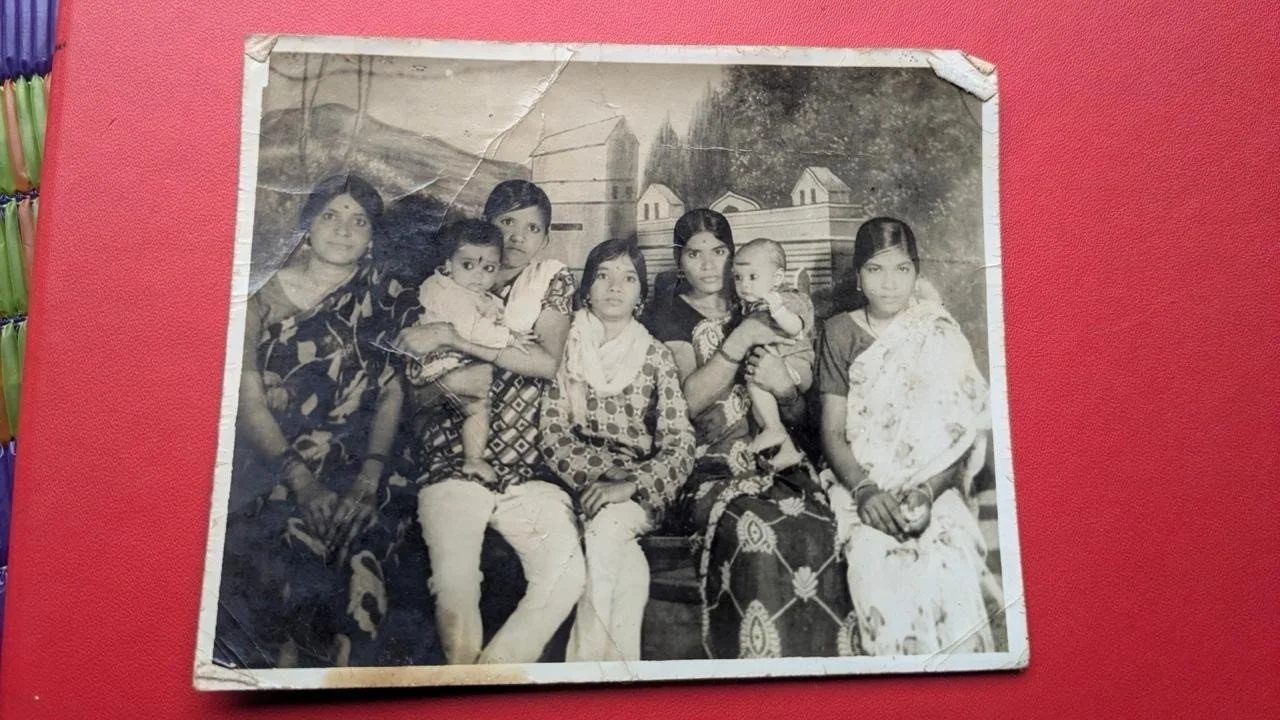
Laughter presents another controlled domain. Old studio portraits from her mother's village show women who arranged the entire photo session yet sit stern-faced and unsmiling (photo below). "If women are laughing out loud, it's a commentary on their character". Women are expected to maintain the persona of control and humility.
Copyright Surabhi Yadav
(Surabhi took the photo of the photo. The second woman from the left is her mother. It was taken in a professional photo studio back in the late 1970s or 1980s).
Access to public space shifts around puberty. Girls play freely outdoors until adolescence, then face restriction. "You start seeing very few adolescent girls and very few women playing out in public", while boys and men continue occupying these spaces. The play doesn't stop, it moves indoors, sometimes only resuming in old age after decades of socially-defined limitation.
The complex role of religion
"A lot of religious practices come at the expense of women's freedom", Surabhi acknowledges. Yet "religion is also the biggest social sanctioning that women get to be at leisure".
In religious contexts, women can sing, dance, travel without male companions, occupy public space late at night. Surabhi shows a photograph of women at a temple, staying past midnight, a freedom usually unavailable in other social settings. (below)
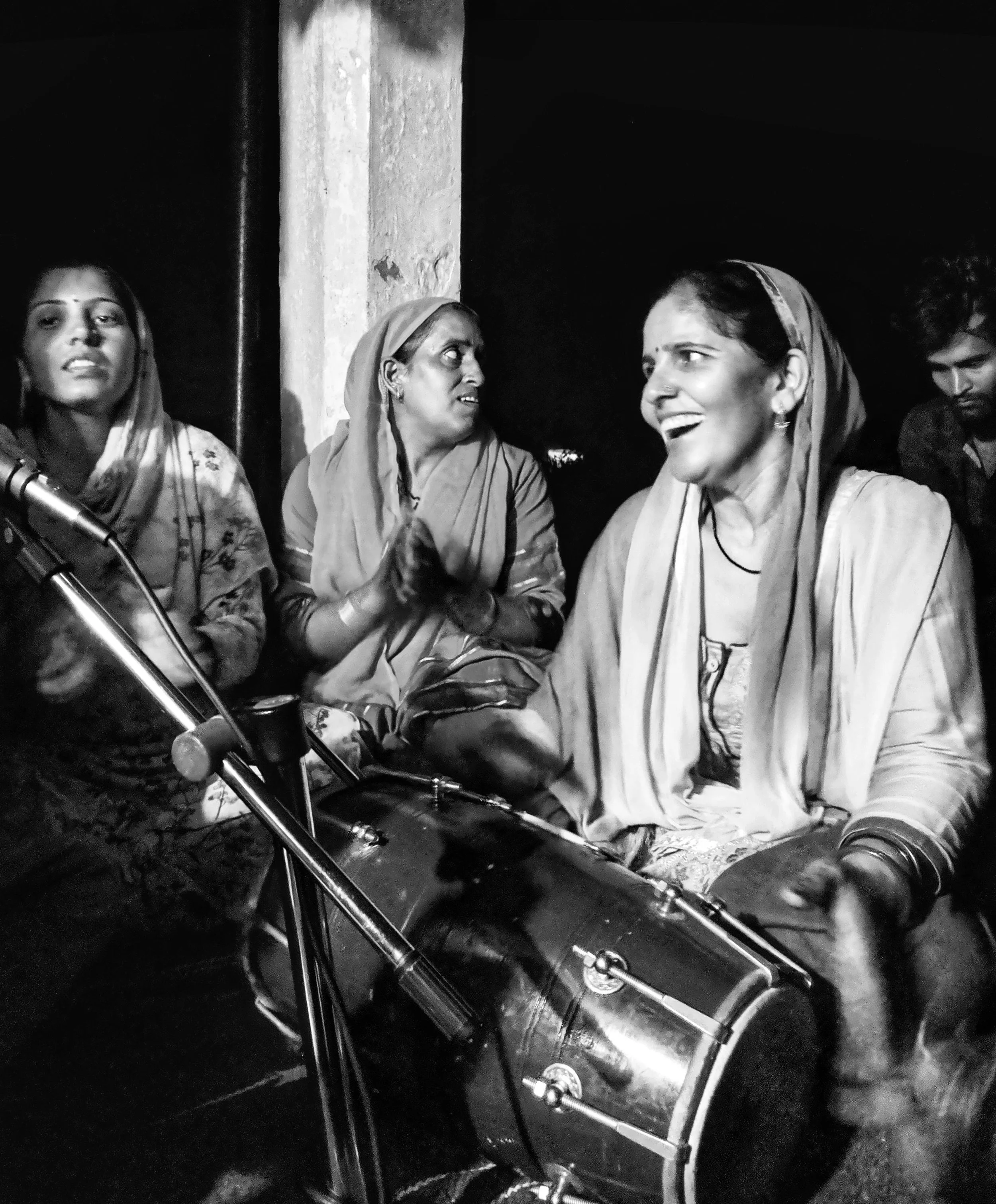
Copyright Sukkhad (H.P)
During the discussion, an audience member asks about the paradox of religious structure and freedom. Surabhi's explanation centers on necessity. "Leisure is an innate need," she argues. "When women don't have alternatives, they had to create it somewhere." Religious spaces are accessible and socially approved, so women created rituals within them.
She offers a concrete example: in her village, women can't join wedding processions. So when villages empty of men attending celebrations, women recreate entire weddings inside homes. Someone becomes the groom, someone the bride and elaborate performances follow. "Is it complete? Is it enough? Probably not. But what are you going do when this is the only access you're given?"
Daily Oppression
Surabhi challenges the notion of oppression as only existing in dramatic acts. The way that women have their actions governed by others and society at large daily plays a larger role in a woman’s sense of access to the world.
All oppressive systems function by establishing hierarchies, staging some people as ‘less than’ others. "Oppression is a lot about telling you how not to be." Leisure can function as a way to counter this. Self-definition, even within a small group of peers allows open subcultures to form, creating safe spaces, flipping ‘how not to be’ to ‘the way we are’.
The project's name reflects this. Basanti, Surabhi’s mother's name, means ‘Spring’ in Hindi. "Spring is the time that allows flourishing, and leisure is the time that allows flourishing of self." This flourishing enables self-actualisation.
Surabhi connects this to the evolving face of feminism in India. Contemporary feminism often operates reactively: The patriarchy says streets are unsafe at night, women organise midnight marches. "How much we're going to succeed is decided by what level the patriarchy is poking us. We are in the reactive and the fighting mode."
Surabhi asks how we can use leisure to move forward to create not only safe spaces and niches for women, but places and contexts that are truly inclusive for all people. This was a call to action to the audience of young leisure professionals to consider access in many forms.
Urban/Rural Differences
Asked about changes over seven years, Surabhi identifies a "new language and a new gaze" emerging in urban, female-oriented spaces, expressing a movement towards this more inclusive future. Men particularly express surprise at the difference of experience between genders: "How did I not see what my mother does when she's not being my mother?" But structural change remains limited. "Gender norms, caste norms, public spaces...it's not a very inclusive access yet."
Rural-urban comparisons show two key differences. Rural communities maintain easier access to collective activities such as singing, dancing, playing together as integral to individual leisure. Urban spaces show more fragmentation. Second, rural areas demonstrate more ease around self-worth. "The idea of 'are you worthy enough' is a very urban idea." Village shopkeepers close for afternoon naps; city workers don't. "'I have enough' is a lot more accessible in villages than in urban areas."
The audience of young people seem to confirm capitalist productivity culture's reach. In the discussion, multiple described a sense of guilt during ‘pure’ leisure, feeling the need for recreational activities to serve a self-improvement role.
One noted having many options but feeling ‘stuck’ between work and pleasure, unable to enjoy either. Surabhi frames this as the (negative) system functioning: "As long as you're running, the system succeeds."
The Project
The Women at Leisure archive currently serves as a public narrative, building awareness through social media. The work remains primarily documentation and conversation, making visible what stays unseen, creating language for under-examined experiences, asking audiences to notice absences in their contexts.
Surabhi's work demonstrates several points relevant to leisure studies. First, defining leisure requires attention to whose leisure is studied. Conventional definitions may not capture how leisure operates for those with different structural constraints.
Second, leisure access functions as a metric for social equity across multiple dimensions, be they gender, age, class, caste, location, ability. Who gets to rest, play and occupy public space, and reveals social hierarchies.
Third, marginalised communities often develop creative leisure practices within constraints, which shouldn't be romanticised but recognised as making do with insufficient alternatives. The goal isn't celebrating adaptations but expanding options.
Fourth, invisibility of certain people's leisure isn't accidental but actively produced through what gets photographed, valued, studied. Creating counter-archives matters for shifting what becomes imaginable.
The project's success proves how uncommon representations of women enjoying informal leisure remain. Surabhi notes: "In an ideal world, this project should not be famous, because there shouldn't be anything interesting about a woman just sleeping." The fact that such images remain noteworthy indicates how much work remains toward equitable leisure access.
Surabhi
Since 2020, Surabhi and her team have enabled rural young women grow their skills, salary, satisfaction, support system and most importantly, their opinions. With her dream to create a series of Sapna centers in every village, Surabhi has been working on her cause starting with Kandbari, a picturesque Himachal Pradesh village.
Her obsession with the informal way rural women would relax together, and the different personalities that would emerge in leisure time, led her to create Basanti: Women at Leisure. This platform shares stories and visions of women’s experiences of leisure time.
