
Growing Greener Neighbourhoods
I had the honour of giving the keynote speech at the Growing Greener Neighbourhoods Conference at Queen's University Belfast. A huge thank you to Neil Galway and Áine McBeth for putting together such a thoughtful, well-run day, and for inviting me to share a Rotterdam perspective alongside so many people doing brilliant work on the ground in Belfast.
I learned a lot from the morning's sessions, and it was a genuine pleasure to spend the day in a room full of people who care about the same messy, hopeful work of greening cities.
As I knew I would be in the presence of so many experienced practitioners, I wanted to give an honest, on-the-ground account of what community-based greening actually looks like at street level, and then show how that connects to the much bigger strategic ambitions that Rotterdam has set itself.
A shared challenge with Belfast
Rotterdam and Belfast have a lot in common. Rotterdam is home to roughly 651,000 people, with about 20% green cover and 35% water. Like Belfast, it's a city shaped by an industrial past: Europe's largest port is steadily moving further out to sea, leaving post-industrial land behind it. Post-industrial land, climate adaptation and equitable access to green space are challenges both cities are wrestling with, which felt like a natural starting point for the conversation. From high up, Rotterdam already has a strong reputation for innovative, community-based green development, with places like Dakpark, Hofbogen Park and Rijnhaven well known internationally. I wanted to take the audience somewhere less well-known, with a short walk around my own neighbourhood.
A walk through west-Rotterdam
My neighbourhood sits just north of a slowly decommissioning port, now a creative district (M4H) on its way to becoming mixed-use residential and business space. It's largely residential, built up through 1920s–30s terraced housing and 1930s–50s low-rise apartments, economically somewhat depressed, and home to a large immigrant population, largely from North Africa and Eastern Europe.
It is not the Rotterdam most visitors see, and that's exactly why I wanted to show it. The walk had a few stops: Franselaan and the streets around it, where the municipality was digging up the street for services and used the opportunity to run a genuinely participatory redesign process. The street layout mostly came from the standard design book, but the greenery was shaped by residents, who were invited to plant geveltuinen (façade gardens) along the frontages.
The façade gardens themselves, which are booming in popularity across the Netherlands thanks to campaigns like NK Tegelwippen: the national "tile-flipping" competition, where councils and residents compete to rip up paving slabs and plant something instead. The organisers provide topsoil and even a ‘tile taxi’ to take the old slabs away; well over 22 million tiles have been removed nationally since the project began, with more than 2 million more in the most recent year alone.
I went back with my camera expecting the gardens near me to have gone to seed. Most hadn't, and a few were immaculate, one had all but disappeared, and my favourite was one where the residents had embraced weeds and the pollinators that popped up naturally.
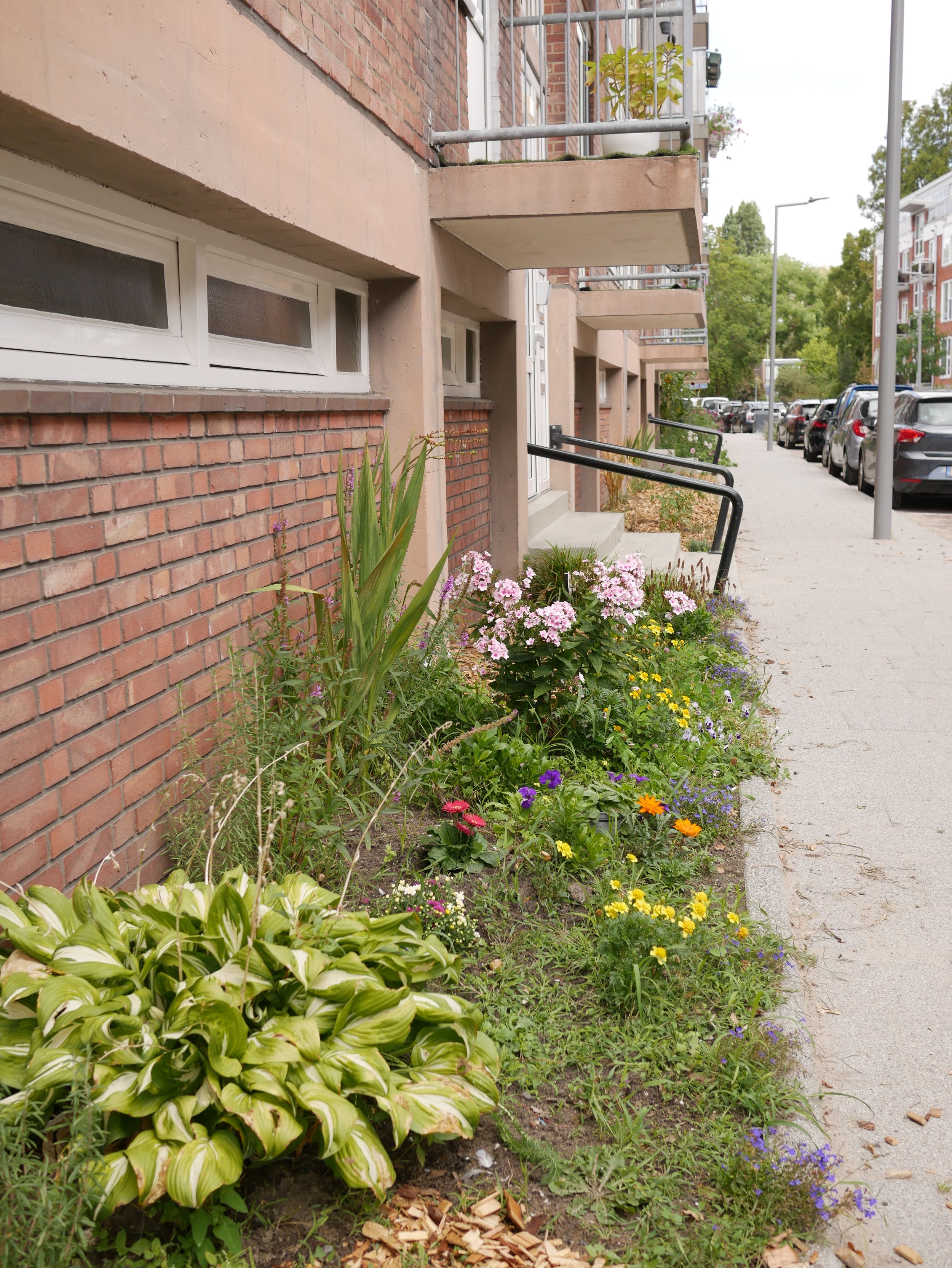
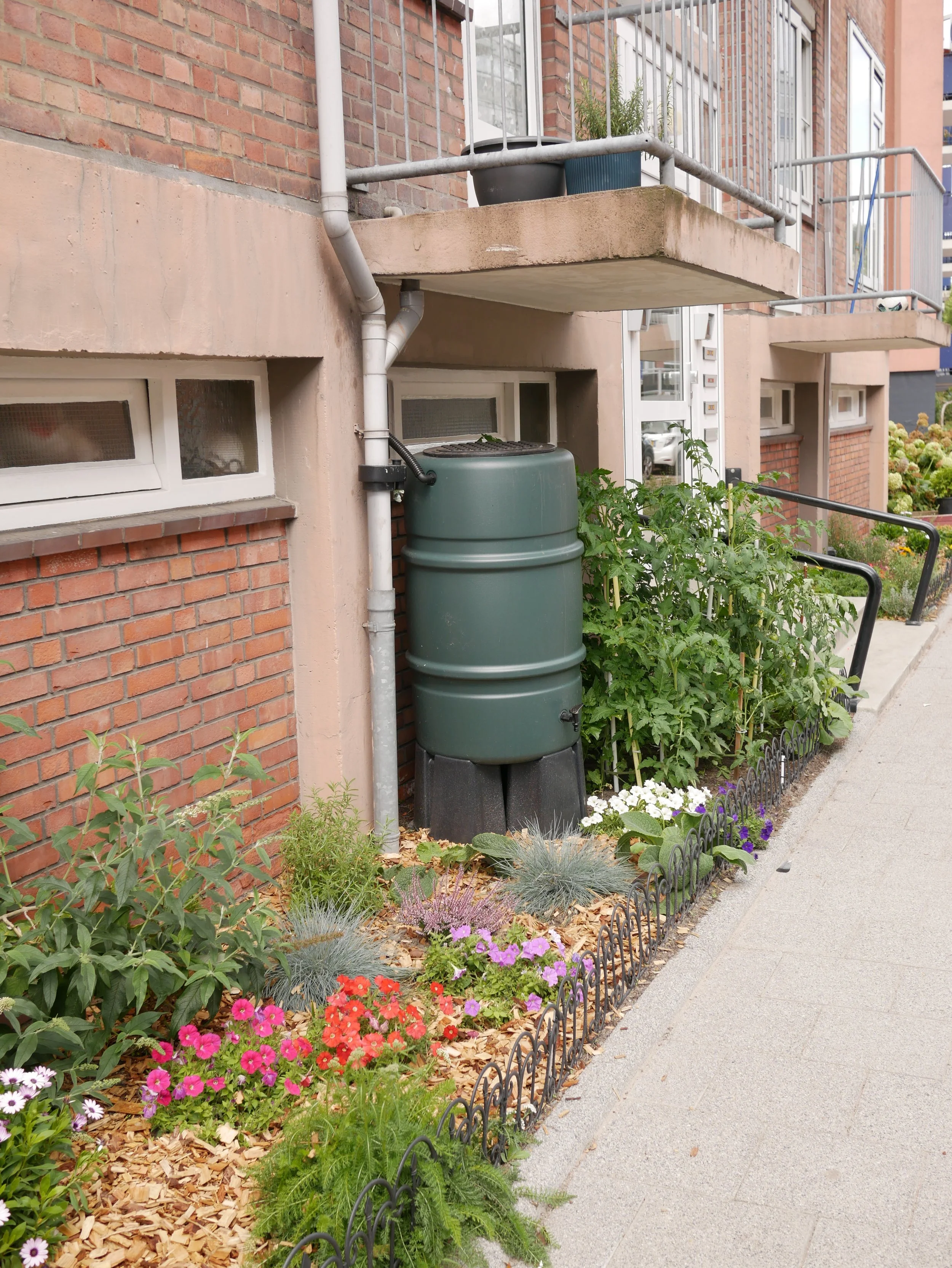
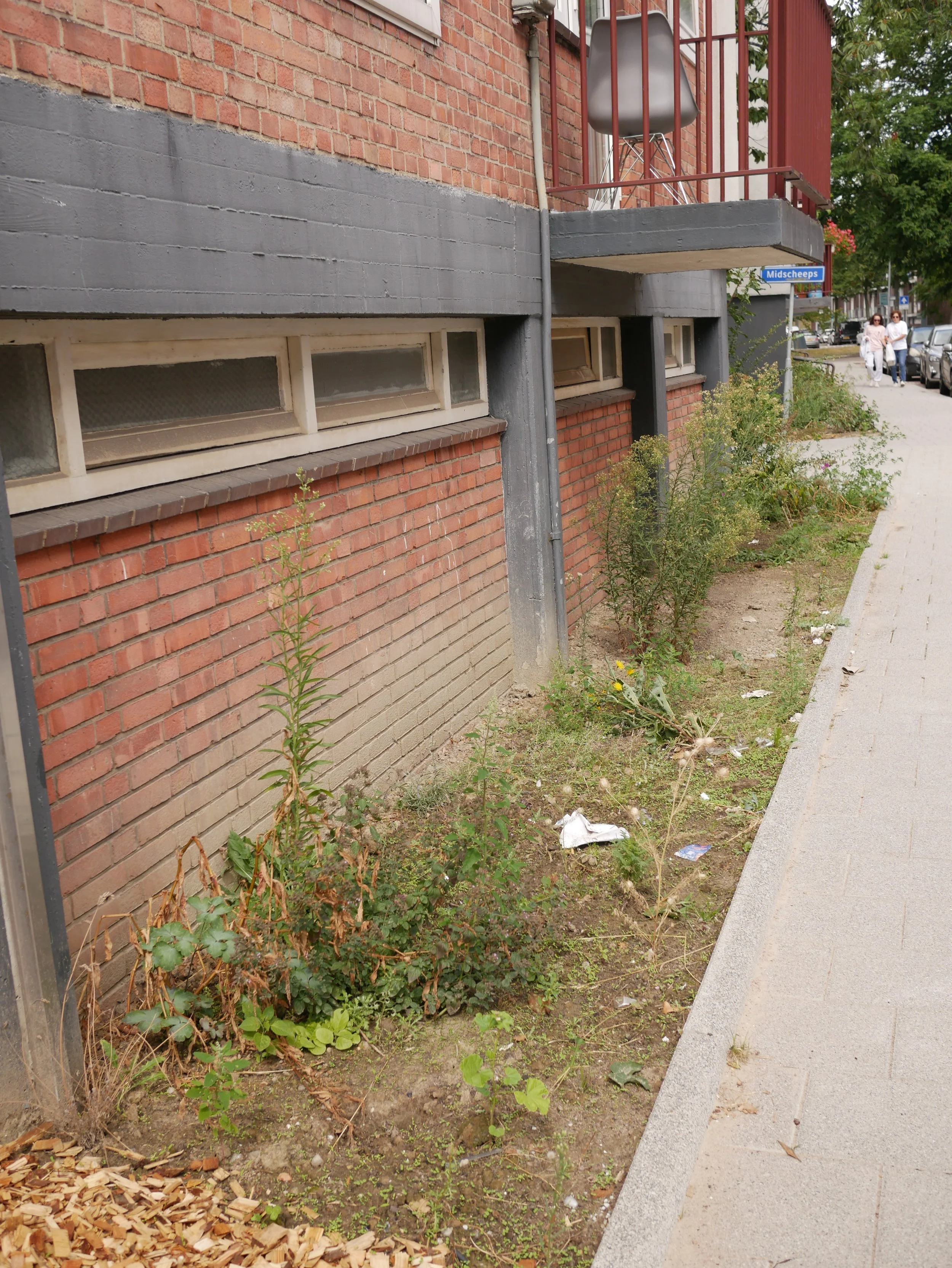
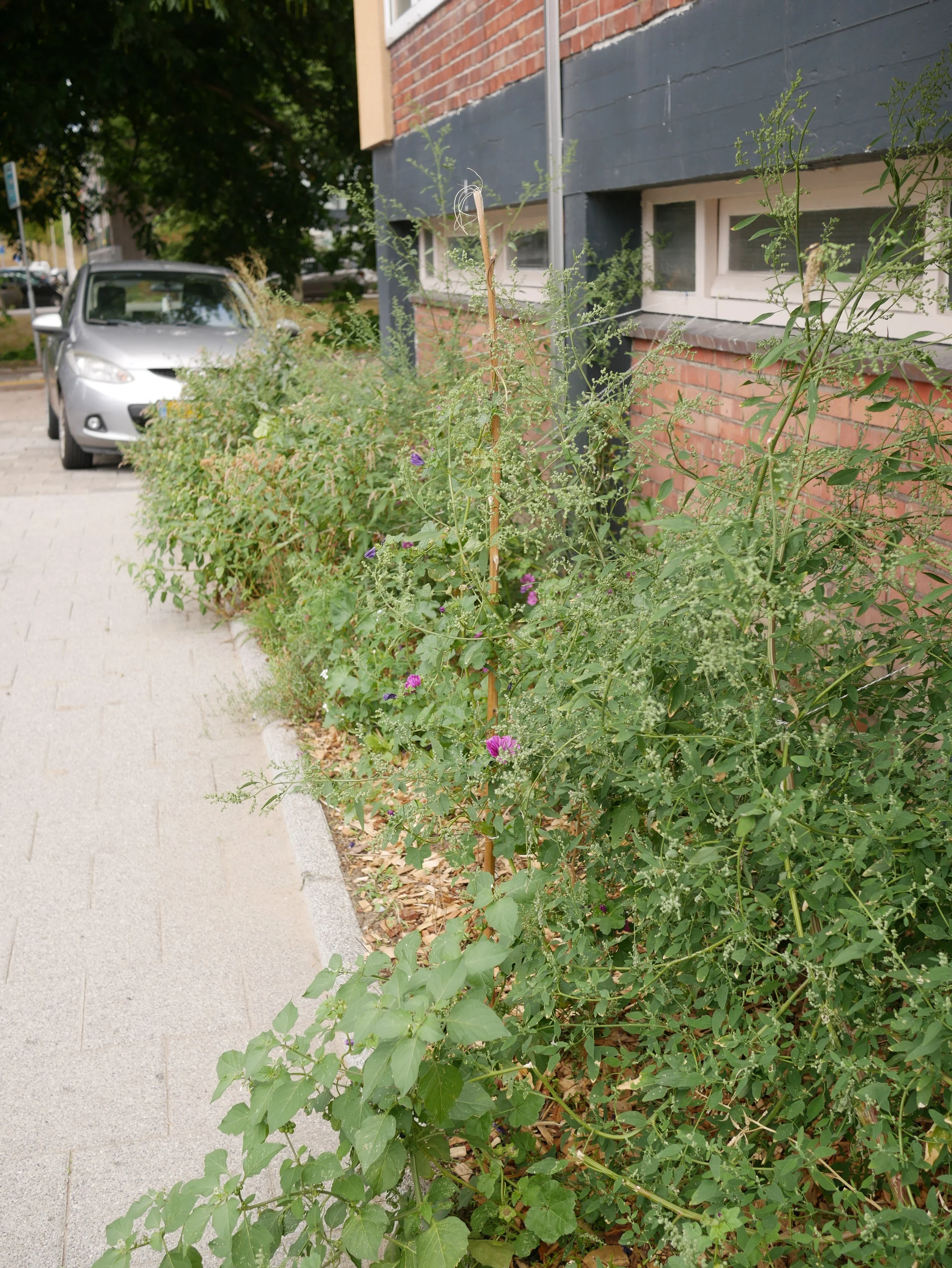
The base of the street trees, where the municipality has been widening the planting pits, partly to manage surface run-off and partly, I suspect, to invite residents to use the space themselves. It's a mixed bag so far. This summer has been unusually hot, so things didn’t look great, but it shows that if you give people an opening and don't tear down what they build, you get real local pride out of it.
A local primary school on Pinkstraat, where the playground's paving is being swapped for permeable, green surfacing, and the perimeter fencing is coming down to fold the yard into the wider public space. Removing the fence turns upkeep from a caretaker's job into a shared, community responsibility.
Groene Buren, a multi-stakeholder organisation that helps coordinate and support community greening projects locally. On the day I visited, they were delivering wood chips to help residents suppress weeds in their façade gardens. I watched an elderly neighbour topping hers up, visibly delighted.
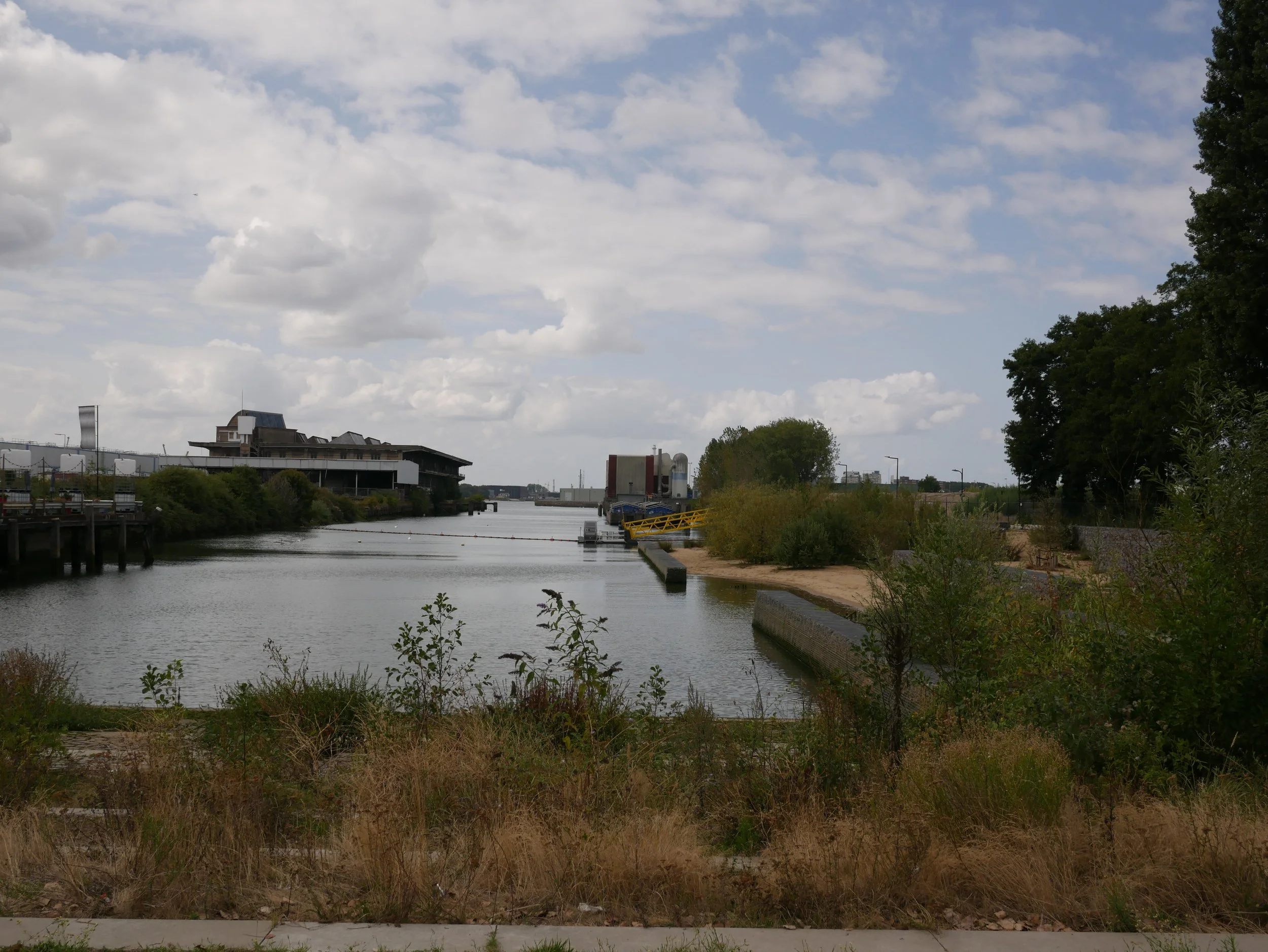
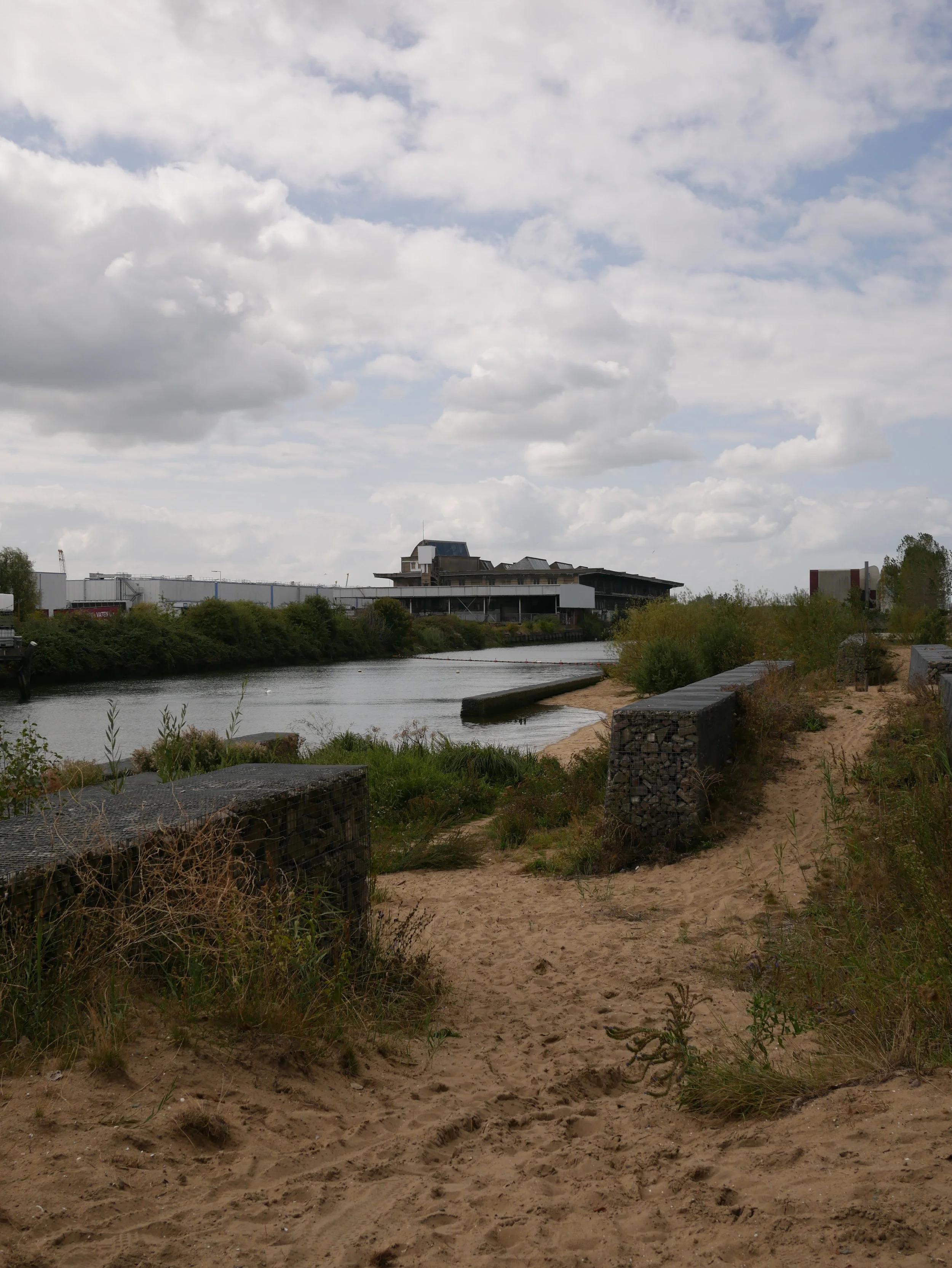
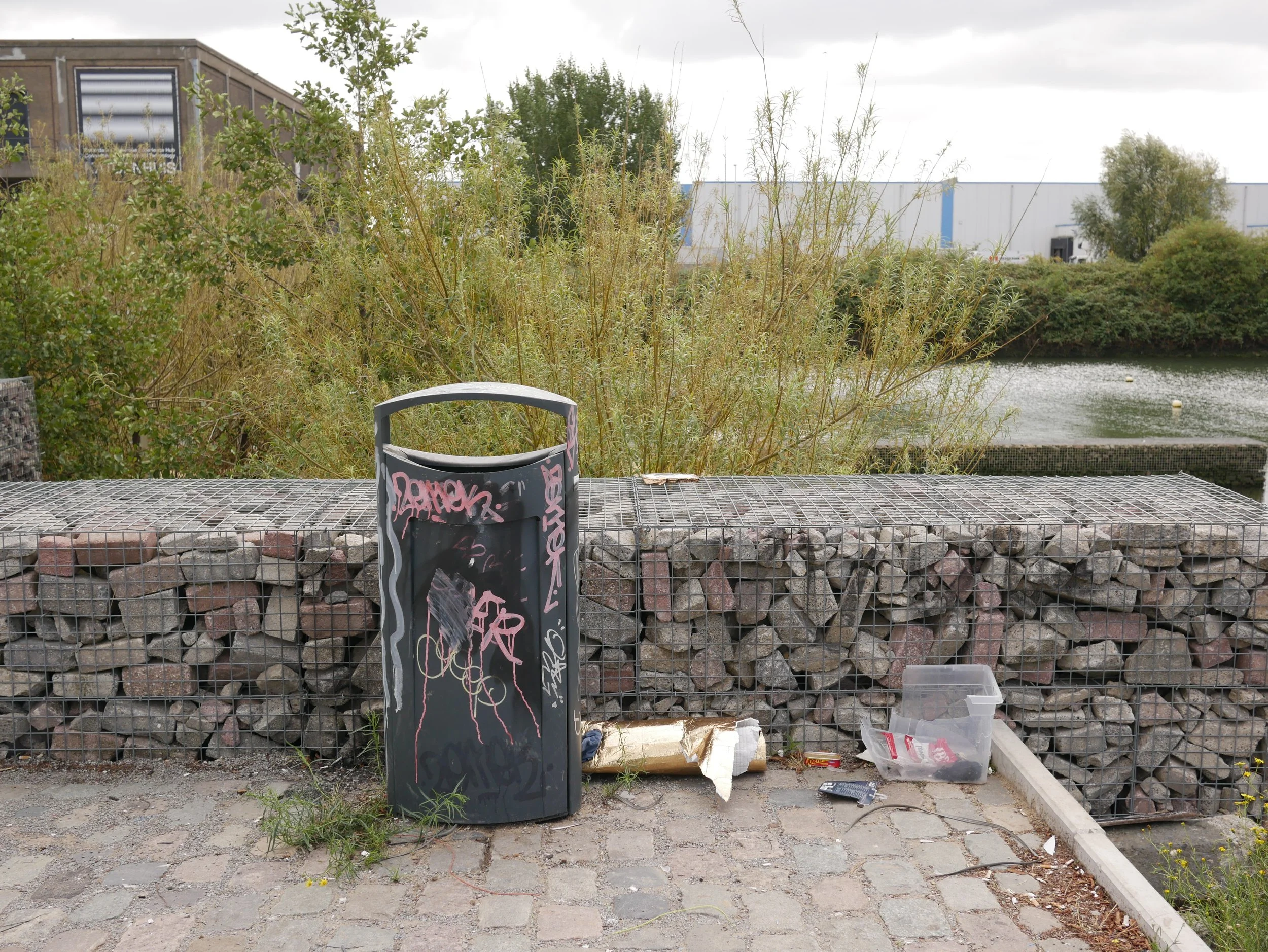
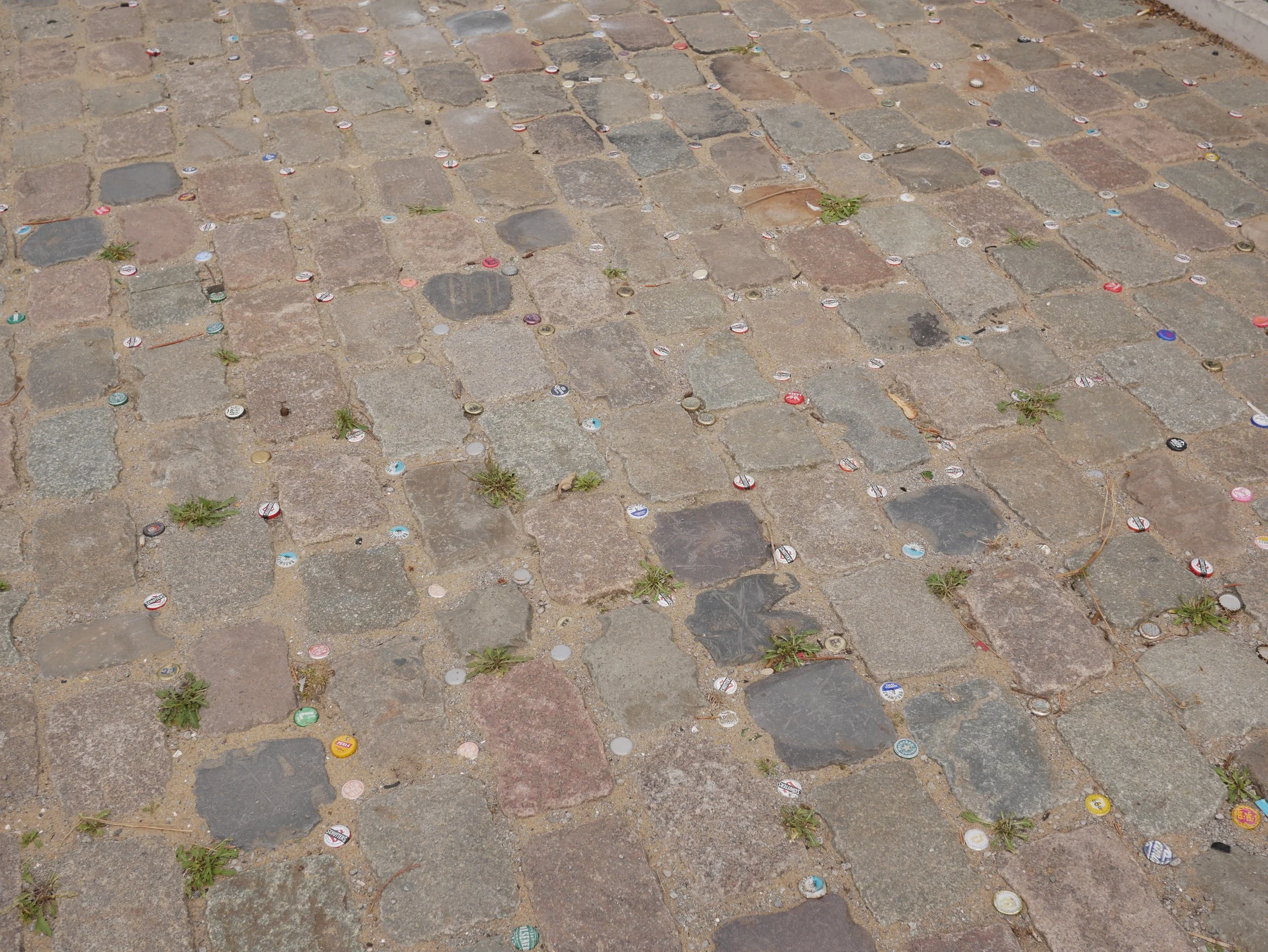
Keilehaven, a new tidal park near the old docks, initiated by the urban design studio De Urbanisten. It's designed from a primarily ecological perspective, but people use it too, and use it respectfully: rubbish gets left next to the bin rather than thrown on the ground, a small but telling sign that people feel the place is worth looking after. It's also the start of a longer plan to soften the hard edges between the city and the water.
The stops on the route were chosen because they are small-scale and local, but each one is part of a much bigger, city-wide programme.
Zooming out: Rotterdam's green strategy
In 2022, Rotterdam adopted a target of 20 hectares of new green space city-wide by 2026, delivered through thousands of top-down and bottom-up projects organised across six tracks: greenery close to home, greenery in the community, climate squares, green routes along the water, improving existing parks, and biodiversity.
It's a genuinely large strategic programme, but as Rotterdam's Deputy Mayor for Public Space and Mobility, Pascal Lansink-Bastemeijer, put it:
"The most important added value of greening is that it improves the quality of life. Greenery recognises no differences; greenery gives every resident of Rotterdam the same enjoyment, the same beauty and sense of lightness. Every tree is a beacon of peace in the hustle and bustle of everyday life."
Every strategy needs a big "why" behind it, and behind Rotterdam's is exactly that: quality of life and equitable access to green space for every resident, alongside the harder climate-adaptation numbers.
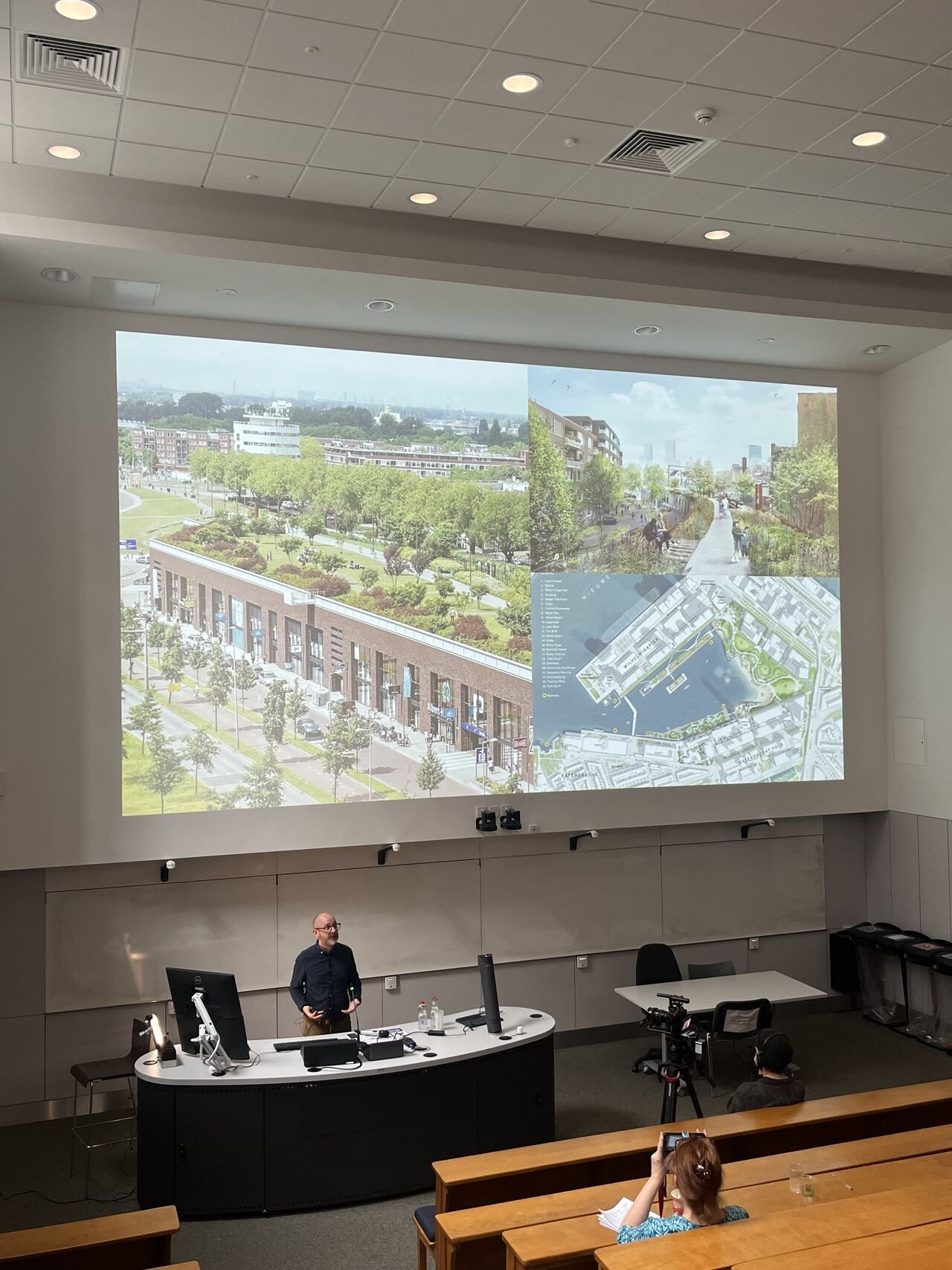
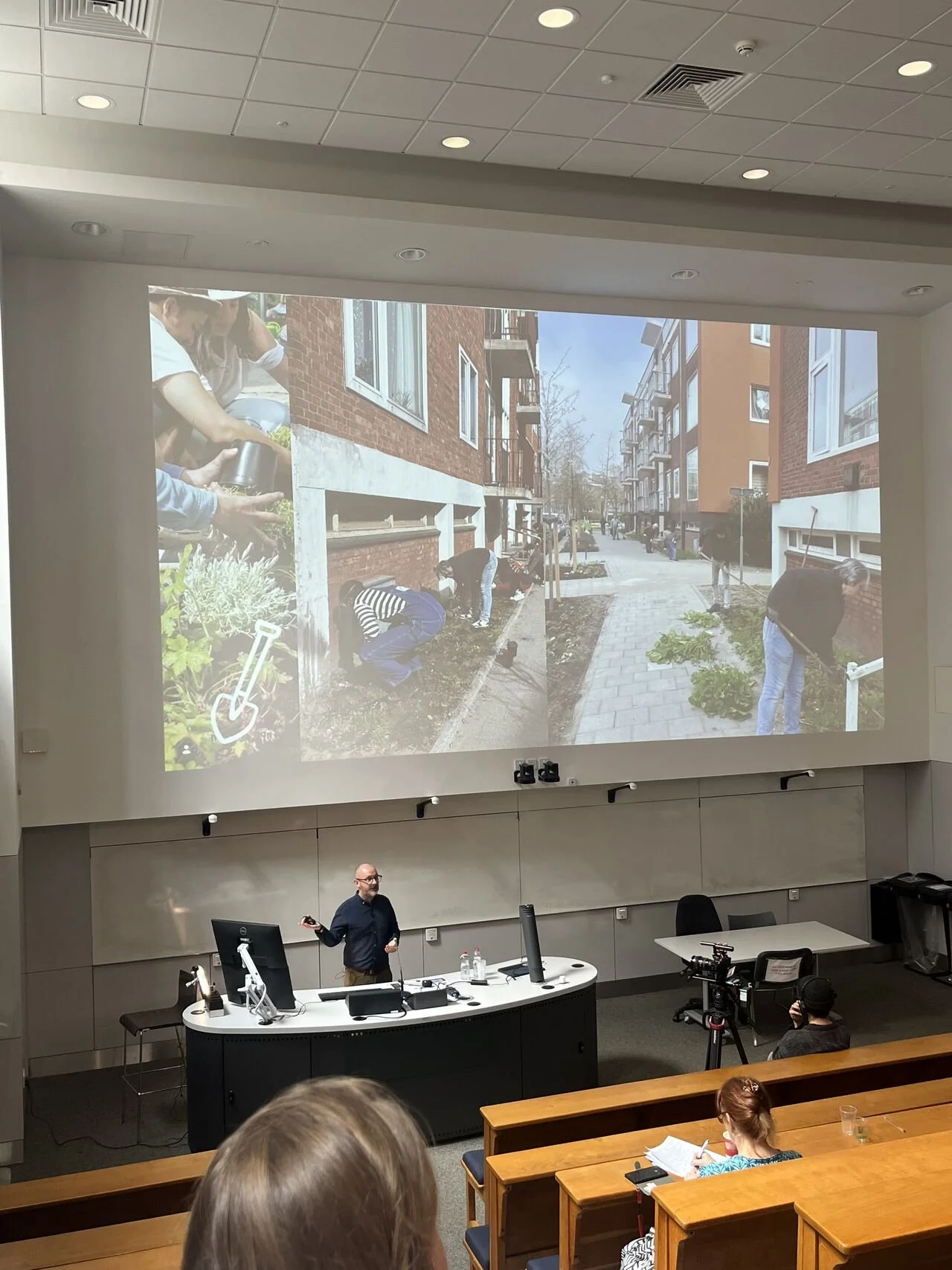
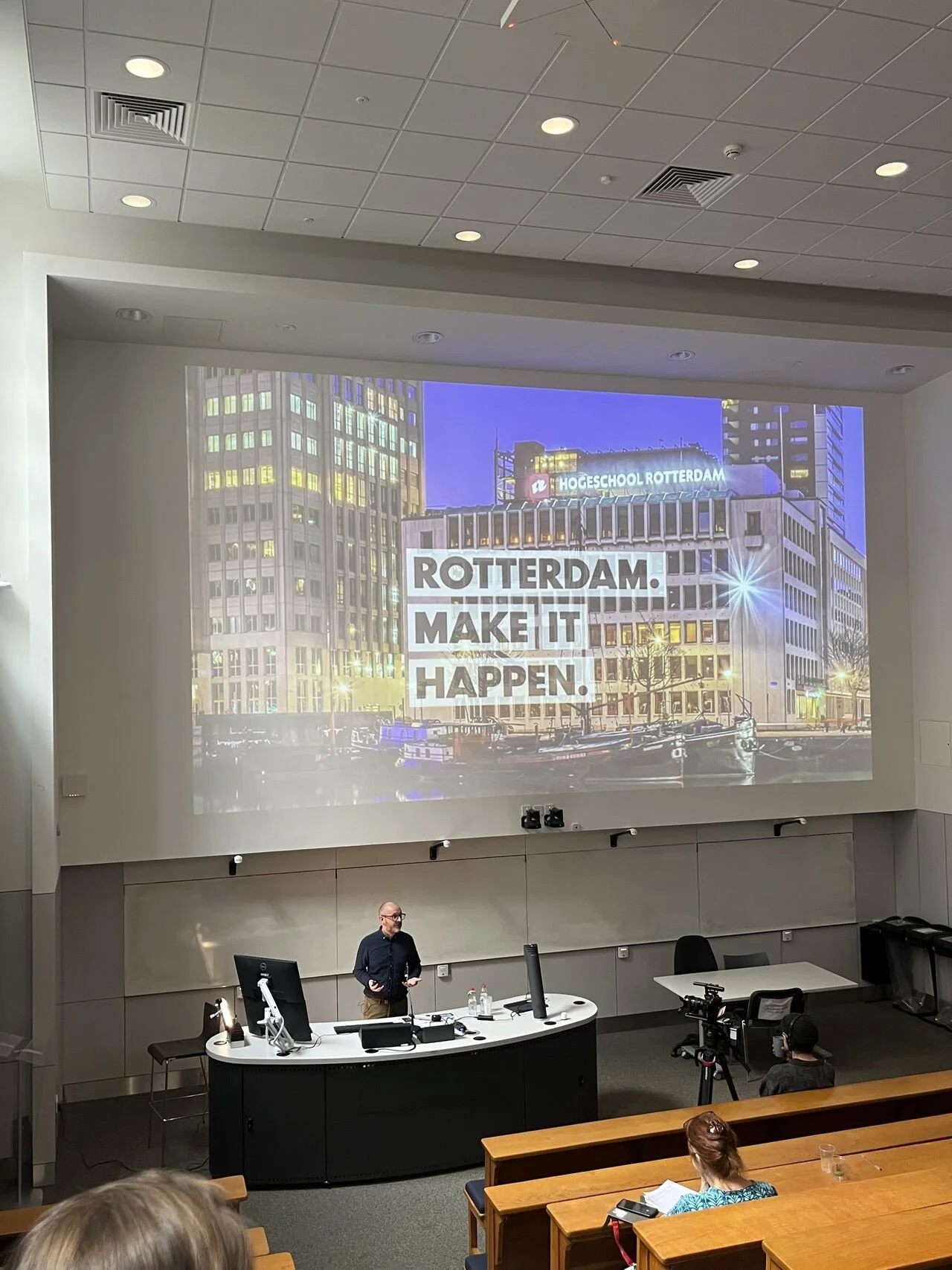
Thanks to Tom Spillane for capturing me mid-flow
Two routes to National Park City status
That larger strategic ambition has started to crystallise into something more formal: a bid to become a National Park City, an international movement that recognises cities actively working to weave nature back into everyday urban life.
Rotterdam and Breda are coming at the application from very different starting points, which made for a useful comparison for the room: Rotterdam is still a grassroots campaign. It grew out of the city's EdiCitNet Living Lab and is led by the civic greening association Groen010 and its volunteers, with no dedicated governing foundation yet in place. It was publicly launched in March 2023, inviting residents, schools, businesses and faith groups to sign a manifesto for a greener city; the municipality signed on only after the citizen-led campaign had already built momentum.
Breda, by contrast, is already there. It was recognised in May 2025 as the first National Park City in the Netherlands and the EU, and the fourth in the world after London, Adelaide and Chattanooga. It's run by an independent foundation, Stichting Breda National Park City, a citizen-rooted body rather than a municipal department, with the municipality (Gemeente Breda) as a founding partner embedding the same ambition into its own policy. About 60% of Breda's area is green space, with old forest, tiny forests, canals, wetlands and community food-growing sitting alongside everyday streets.
It sits within the Van Gogh Nationaal Park, its status is internationally accredited by the National Park City Foundation, and it's led by a director with a background in a regional water authority. The ambition is to be one of the most nature-rich cities in Europe by 2030, with green woven into flood and heat resilience rather than treated as decoration.
Two very different routes to the same designation. One institution-led, one citizen-led, each carrying its own risks: the institution-led route can feel imposed and has to win buy-in; the citizen-led route can stall while it waits for institutional funding to catch up.
Five take-aways
I closed with five take-aways, which I hoped would be valuable for the workshops later in the day.
Ownership matters more than scale. A €500 street planting and a €4.5 million climate square both work when someone local feels it's theirs.
"Who decides" has no single right answer. Breda's institution-led route and Rotterdam's citizen-led route are both legitimate, each carrying different risks.
Make a competition of it. Let neighbourhoods and cities compete against each other to show how much impact they can make locally. Everyone wants to live in the best street in town.
Make it strategic. Small-scale actions should feed into the larger strategic goals of the city, making them easy to argue for.
It's easier to ask forgiveness than permission. Don't undo good community work just because the correct forms weren't submitted. Community work is, by nature, a little messy.
Thanks again to Neil and Áine for such a well-organised conference, and to everyone in the room who asked such sharp questions afterwards.
