
The Next Generation of City Makers and a Good Place bench
I was kindly invited by Robin Cox to join him for a conversation during Utopian Hours in Rotterdam. Good Place is an interview podcast series, where people are invited onto a public bench, for a conversation about life and the place they live.
You can watch the full interview here
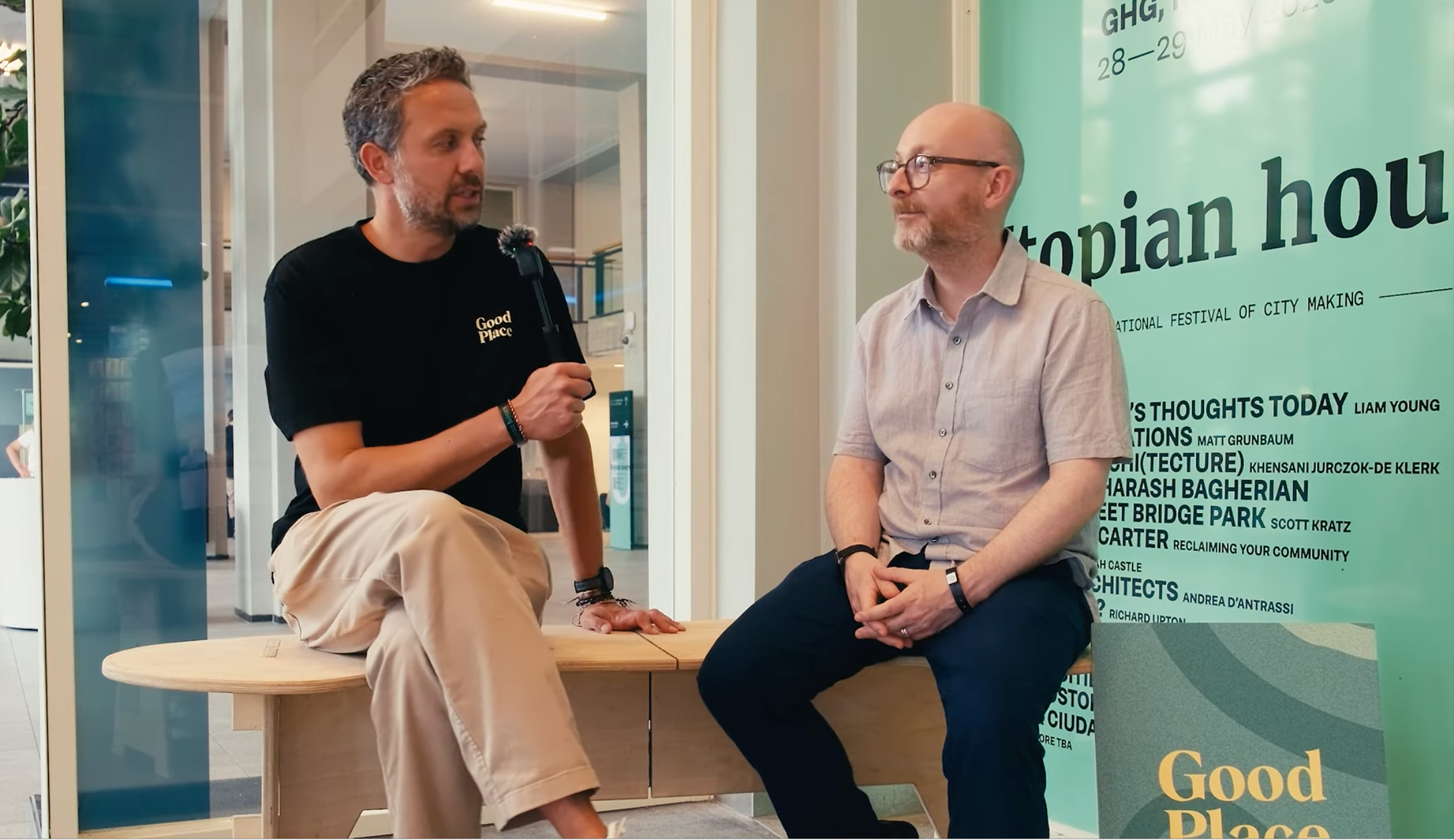
Robin and me on the bench
What does Gen Z actually want?
This was the question I found most interesting to answer, mostly because there's a real gap between what universities assume students want and what students are actually telling us.
"They all want to create impact. They don't want to just work for a company. They're not about making money. They're really about wanting to make the world a better place."
Place, not city
Robin pushed on a distinction that comes up a lot: what's the difference between placemaking and city-making?
I think for students, the scale is really important. At a ‘place’ scale, they are able to make visible impact, without needing to fully comprehend the whole city-wide structures of power and governance. This gives them the quick wins, which are drastically important for them to keep momentum in their studies.
A project from this year illustrated it well. Second-year ULP students in Breda helped establish a community meeting point in an area where a school for refugee children had created some friction with the surrounding neighbourhood. Hospitality students from another college came in to cook shared meals, weekly meet ups were arranged, and the local community gradually took ownership. The students were able to step back and the programme is still running.
The relay system
Education runs on term times that don't map onto the slower rhythms of community development. The solution we've tried to establish is a relay, with projects passed between cohorts, second years to graduation students, one year to the next, with the Urban Living Lab in Breda holding the thread between them. It addresses one of the chronic weaknesses of student-led community work and the hard stop when the semester ends.
What makes a good place?
Robin ends every Good Place conversation with the same question. I tried to turn it around.
"I think it's the other way around. I think it's the bench that makes the place … because just by putting somewhere to sit and to be … creates new ideas, new connections with a place. It will be used how it's used."
I think that’s the key to practicing placemaking. Good design creates conditions rather than outcomes, and then gets out of the way. A bench doesn't prescribe its use, it offers a possibility and lets people decide.
"With a bench, you can create a good place just by putting it there."
You can watch the full Utopian Hours YouTube playlist here
